
Why Every Local Service Business Needs More Than Just a Website
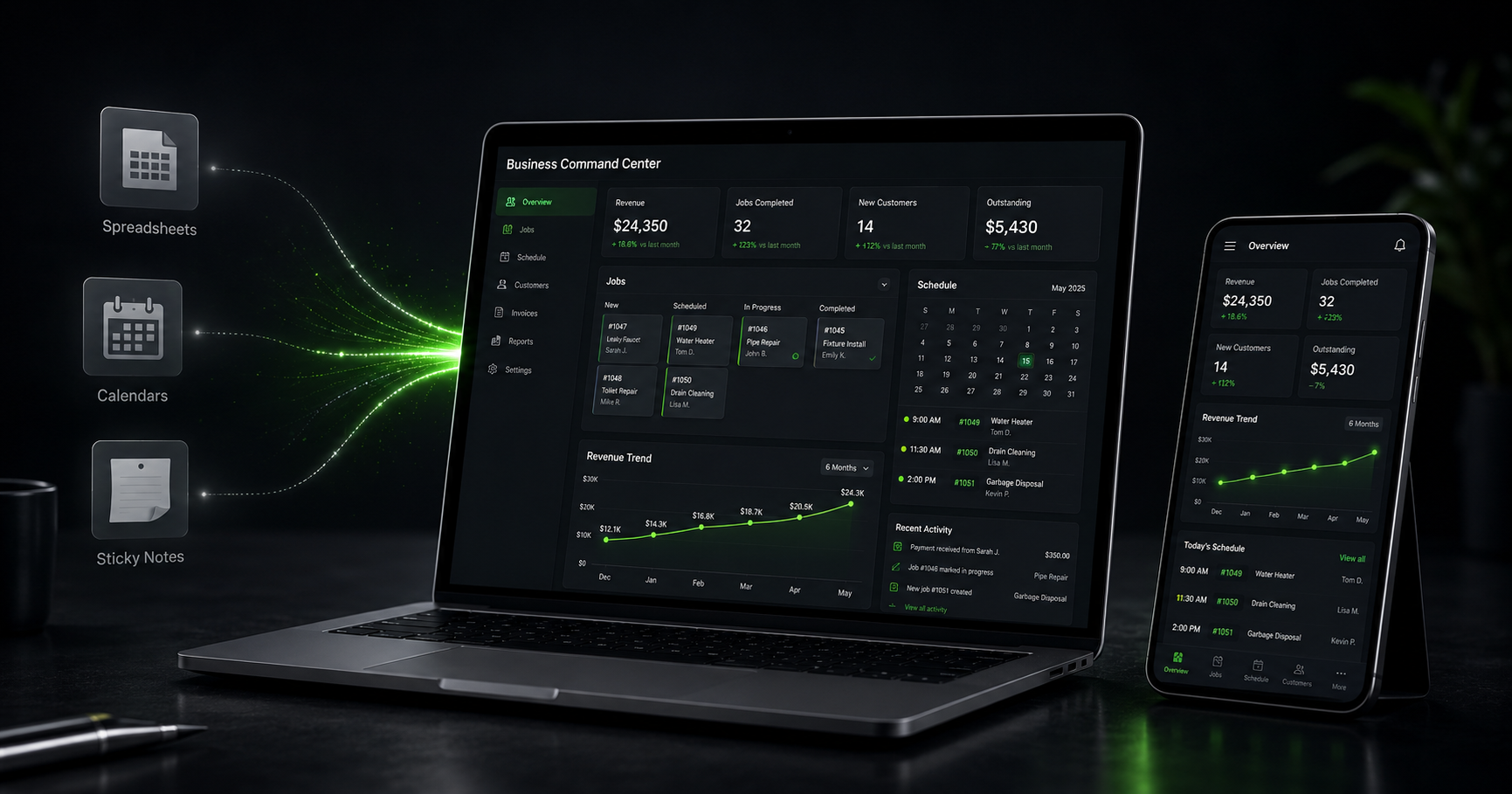
A website is your front door, it's what gets someone to call, fill out a form, or book a job. But what happens the moment after that? For a lot of local service businesses, the answer is still a mix of a paper calendar, a spreadsheet, a stack of sticky notes, and whatever the technician remembers from the truck. That gap between the front end (your marketing) and the back end (actually running the business) is where real money and hours quietly disappear every week.
# The real cost of disconnected tools
When customer information lives in one place, scheduling lives in another, and invoicing lives somewhere else entirely, small cracks turn into real problems: a job gets double-booked because two people were checking two different calendars, a follow-up call never happens because nobody wrote it down, or a customer who paid weeks ago still gets a reminder invoice because nobody updated the spreadsheet. None of these mistakes happen because anyone is bad at their job, they happen because the tools were never built to talk to each other.
# What a connected system actually replaces
A real business management system consolidates the handful of things every service business needs anyway: customer records (contact info, history, and notes in one place instead of scattered across texts and memory), job and pipeline tracking (seeing exactly what stage every job is in, from new lead to completed and paid), scheduling (one calendar the whole team can see and trust), payments and invoicing (knowing instantly who's paid, who's pending, and who's overdue), and reporting (real revenue and expense numbers instead of a manual once-a-month scramble). None of these are new problems, they're the same problems every service business has always had, just finally solved in one place instead of five.
# Why "just use a spreadsheet" stops working
A spreadsheet works fine for a handful of customers. It stops working the moment more than one person needs to update it, or a customer needs a reminder sent automatically, or you need to know today's revenue without manually adding up a month of rows. Spreadsheets don't send appointment reminders, don't flag an overdue invoice on their own, and don't give you a real answer when someone asks how the business is actually doing this month. They were never built to run a business in real time, they were built to record numbers after the fact.
# The real payoff: time and visibility
The biggest benefit of a connected system usually isn't the organization itself, it's the visibility that comes with it. Knowing exactly who owes you money without digging through old invoices. Knowing what's on today's schedule without three separate check-ins with your team. Knowing whether this month is actually ahead of last month instead of guessing. That kind of visibility changes how confidently you can make decisions, from hiring to marketing spend to which services to push harder.
# What to look for in a business management system
Not every system is worth switching to. Look for one that's simple enough to use without a training course, genuinely all-in-one instead of five subscriptions pretending to be one product, accessible from a phone since most of the work happens away from a desk, and built around real reporting, not just a prettier to-do list.
Command Center, built into every HighRanx plan, is exactly this: jobs, customers, scheduling, payments, expenses, and reporting in one connected system, with Ask AI able to answer questions about your own business instantly. If you want to see what that actually looks like, our Command Center page walks through it in full.
Ready to see what a real website plan looks like?
See pricing